
Short answer: write ten to twenty questions the way your buyers would ask them, without your brand name, and run each one in ChatGPT in a temporary chat, three times. Note whether you’re named, where you sit in the list, how ChatGPT describes you, which competitors it names instead and which pages it cites. That gives you a baseline in an afternoon. Repeat it monthly, or use a tracker once you know which questions matter.
Your next deal may already have a shortlist before your SDR sends the first message. Half of B2B software buyers (51%) now start their research with an AI chatbot more often than with Google, according to G2’s 2026 survey of 1,076 buyers. The same survey found that 69% ended up choosing a different vendor than they planned because that vendor appeared in a chatbot’s recommendation.
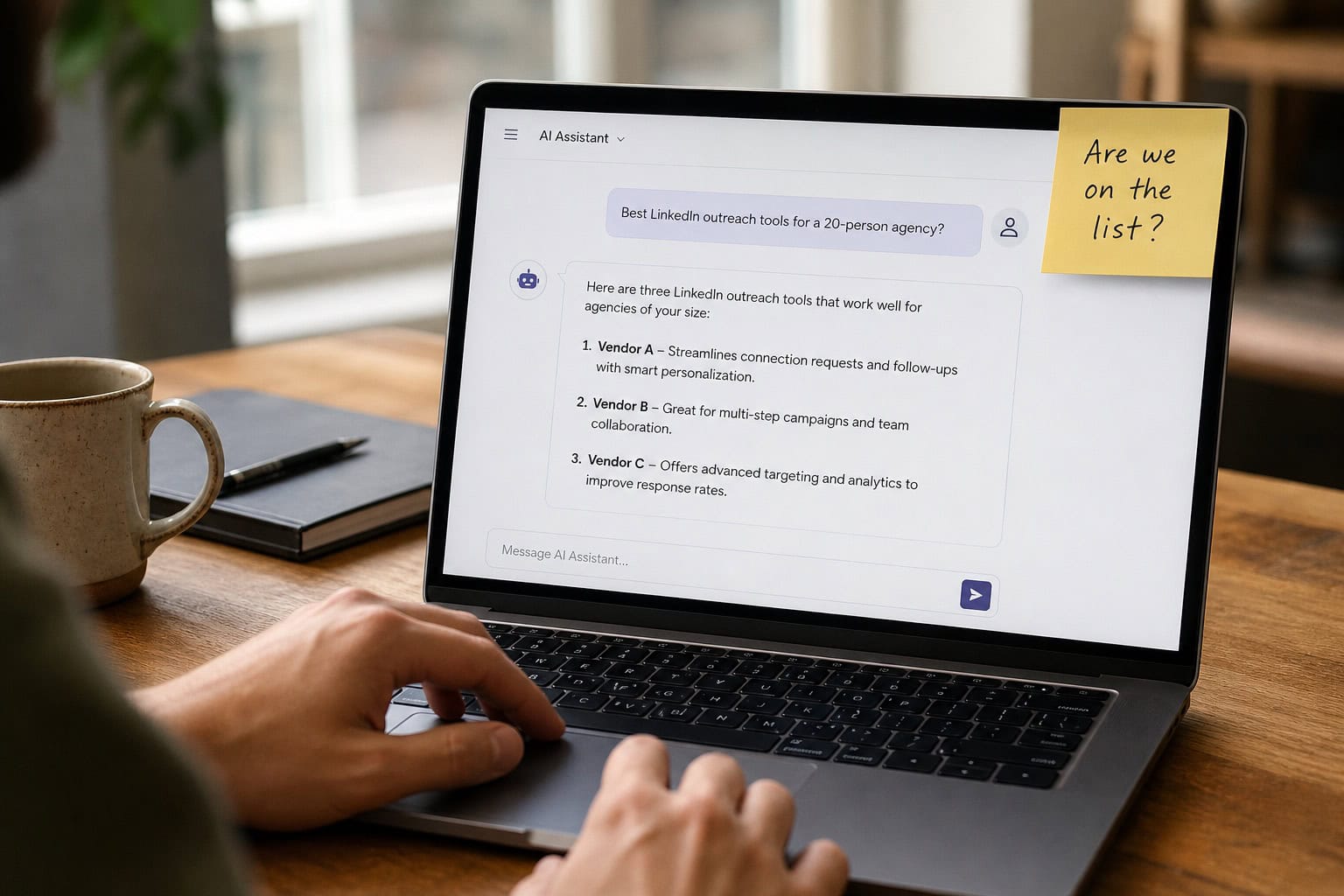
ChatGPT is the biggest of those chatbots: OpenAI reports more than 1 billion weekly active users. When a VP of Sales asks it for “LinkedIn outreach tools for a 20-person agency”, the answer names three to five vendors with a line of reasoning for each. Those vendors get the demo requests. Everyone else learns about the deal when it’s lost, if at all.
The good news is that you can see that answer. It takes no special access, just a method that gives you something more reliable than one screenshot.
Why one quick question tells you almost nothing
Most teams check once. Someone types “what are the best tools for X” into ChatGPT, sees the company named or not, and posts a screenshot in Slack. That check is close to useless, for three reasons.
The answer changes from run to run. ChatGPT doesn’t pull a fixed ranking from a database. It writes each answer fresh, so the same question asked twice can return different vendors in a different order. One run is a sample of one.
Your own account skews it. If memory is on, ChatGPT can use what it knows about you from past chats, so an account that has talked about your product for months will see it come up more often than a buyer will. OpenAI’s memory FAQ explains that saved memories and chat history personalize responses, and can even change the search queries ChatGPT writes.
The wording matters more than you’d expect. “Best LinkedIn automation tool” and “how do agencies run LinkedIn outreach for several clients without getting accounts restricted” are different questions, and they often get different vendors. Buyers ask the second kind.
Where ChatGPT’s recommendations come from
It helps to know the two sources ChatGPT draws on, because the fixes for each are different.
- What the model already knows. Everything the model learned in training, from your website, review sites, forums, comparison articles and news. When ChatGPT answers without searching, this is all it has. A newer company, or one that rebranded recently, is often thin here.
- What ChatGPT search finds right now. For many buying questions, ChatGPT rewrites the question into search queries, searches the web (OpenAI says it sometimes partners with other search providers) and cites the pages it used, with links. OpenAI’s search crawler, OAI-SearchBot, is the one that fetches pages for these answers, and OpenAI says sites that block it won’t appear in ChatGPT search answers (OpenAI crawler docs).
When you check, look for the little source links in the answer. If they’re there, the answer came from search, and the pages it cites are the pages to work on. If there are none, the answer came from the model’s memory, and that changes more slowly.
How to check whether ChatGPT recommends you, step by step
1. Write the questions your buyers ask
Aim for ten to twenty. Leave your brand out of every one: you want to know whether ChatGPT brings you up on its own. Mix four kinds:
- Category questions: “What are the best LinkedIn automation tools for agencies?”
- Problem questions: “How can a small sales team book more meetings from LinkedIn without hiring another SDR?”
- Alternative questions: “What are good alternatives to [your biggest competitor]?”
- Comparison questions: “[Competitor A] vs [Competitor B] for a team of 10, which is better?”
Good sources for the wording: the first line of inbound demo requests, call notes, the “how did you hear about us” field and the questions prospects ask on discovery calls. Your sales team hears buyer language every day; ask them for it.
2. Run them clean
Use a browser where you’re logged out of ChatGPT, or a temporary chat with personalization turned off, so your memories and custom instructions stay out of it. Don’t add context about your company. If your buyers are mostly in one country, run the check from there, or at least note where you ran it from: answers that search the web can differ by location.
3. Run each question three times
Three runs per question is the minimum that tells a pattern from noise. A vendor named in three of three runs is a stable pick. One named once in three is on the edge, which is where a few improvements can move you in or out.
4. Write down five things
Use a simple sheet with a row per run:
| Column | What to record |
|---|---|
| Named? | Yes or no |
| Position | 1st, 2nd, 3rd… in the list, or “mentioned in passing” |
| Description | How ChatGPT describes you, in its words. Is it accurate? Is the pricing right? |
| Competitors | Every other vendor named, in order |
| Sources | The pages it cited, if any |
The description column is the one sales leaders tend to skip and later wish they hadn’t. Being named as “a cheaper option with fewer features” and being named as “the best fit for agencies” are very different recommendations.
5. Do the math
Your mention rate is the share of runs that name you. With 15 questions and 3 runs each, that’s 45 answers. Named in 9 of them? Your mention rate is 20%. Do the same for your top three competitors: the gap between you and them is the number worth watching.
6. Repeat monthly
Models update, ChatGPT search re-reads the web, and competitors publish new pages. A check from last quarter says little about today. Same questions, same method, once a month, so the trend means something.
Automating the check
Doing this by hand for 45 answers takes a couple of hours. It’s worth doing once, because reading the answers yourself teaches you a lot about how ChatGPT sees your category. After that, a tool saves the time.
A free ChatGPT visibility tracker runs this exact exercise for you: give it your domain, and it writes ten buyer-style prompts without your brand in them, runs them on ChatGPT and reports your mention rate, your position, how you’re described and which competitors come up instead. ChatGPT isn’t the only assistant your buyers use, though. To see the same picture across Perplexity, Gemini, Copilot and Google’s AI results in one report, run an AI visibility check for your brand on all of them at once.
How to read what you find
Most teams end up in one of four situations.
You’re not named at all
Check the basics first. Is your site blocking OAI-SearchBot in robots.txt or at the CDN? Does your homepage say, in plain words, what you sell and who it’s for? AI answers lean on clear category language. “The revenue acceleration platform” gives ChatGPT nothing to match against “LinkedIn outreach tool for agencies”.
Then look at the pages ChatGPT cited for competitors. They’re usually review sites like G2, “best tools” roundups and comparison articles. If you’re missing from all of them, that’s your gap, and it’s the same gap a human buyer reading those pages would hit.
You’re named, but described wrong
Outdated pricing, a feature you retired, a positioning you dropped two years ago. This usually comes from old pages that still rank: a 2023 review, a stale comparison, your own old blog posts. Update what you control, ask authors of third-party pages to refresh theirs, and make sure your pricing and product pages state the current facts in text, not only in images.
You’re named, but always after the same competitor
Read the reasons ChatGPT gives for putting them first. They’re often specific: “best for agencies”, “the most integrations”, “strong reviews on G2”. That tells you what proof is missing on your side. Sometimes the fix is content (a page that answers that use case directly), sometimes it’s reviews, sometimes it’s a comparison page that makes your case in your own words.
You’re named on some questions and not others
This is the most useful result. Group the questions where you’re absent. They usually share a theme: a use case, an industry, a company size. That’s the content brief for the next quarter.
What sales teams can do with this
AI visibility sounds like a marketing metric, but sales feels it first.
- Add ChatGPT to “how did you hear about us”. Make it a separate option, not lumped in with “search”. Within a quarter you’ll know how many inbound leads start there.
- Check your analytics for ChatGPT traffic. Look for chatgpt.com among your referral sources and see which pages those visitors land on. It undercounts, because people who copy a link out of the app often arrive as direct traffic, but the trend is still worth watching.
- Ask prospects what they asked. On discovery calls, “what did ChatGPT tell you about us?” is a fair question and often an illuminating one. If it got something wrong, you’ll hear it there first.
- Prepare for the comparison it already made. If ChatGPT always names you next to the same two competitors, your reps should have a crisp answer to “how are you different from them?” before the call starts.
FAQ
Can I pay to be recommended by ChatGPT?
Not in the answer itself. OpenAI now shows ads in ChatGPT, but it says ads are always clearly labeled and separate from the answers, and that advertising does not influence what ChatGPT answers. Being in the answer still comes down to what the model knows and what ChatGPT search finds.
How many questions do I need to track?
Ten to twenty is enough for a first baseline. Most B2B teams end up tracking 50 to 100 once they cover every product line, use case and competitor. More questions run once each are usually worth less than fewer questions run several times.
How often does ChatGPT change its recommendations?
Often enough that a single check goes stale. Answers vary between runs, ChatGPT search re-reads the web continuously, and model updates can shift what the model knows. Monthly checks are a reasonable rhythm for most teams; weekly if you’re actively working to move the number.
Does ranking in Google help me get recommended by ChatGPT?
It helps indirectly. The pages that rank well for buying questions, like review sites and roundups, are often the same ones ChatGPT search cites. But ChatGPT doesn’t copy Google’s ranking, and a strong Google position doesn’t guarantee a mention. Check ChatGPT separately.
Is checking ChatGPT enough?
It’s the best place to start, because it’s the biggest. But B2B buyers also use Perplexity, Microsoft Copilot at work, Gemini and Google’s AI Overviews, and each can name different vendors for the same question. Once your ChatGPT baseline is in place, run the same questions on the others.