
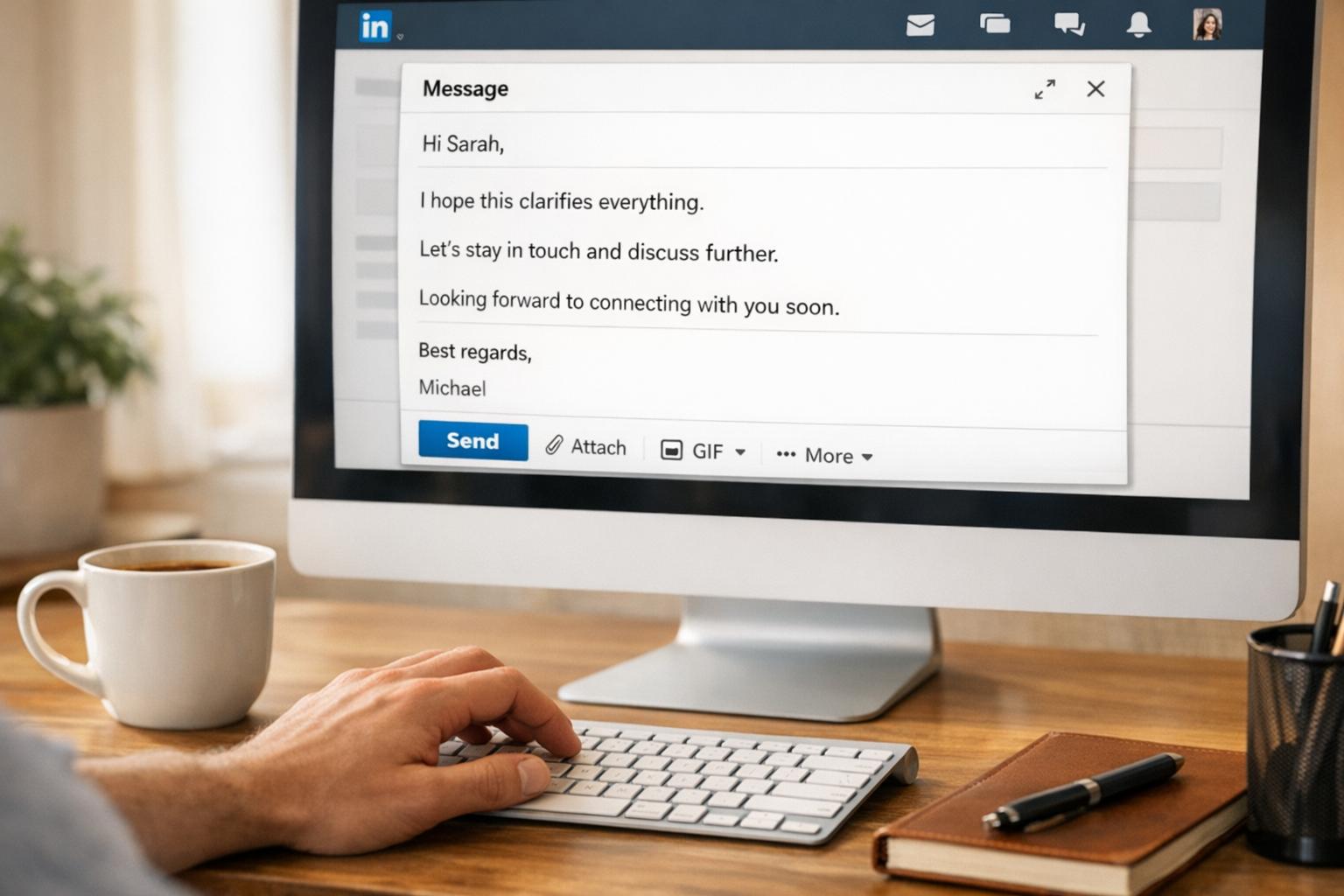
Crafting the perfect LinkedIn message closing can significantly boost your response rates. Here’s why: People often remember the last thing they read, and a strong closing can leave a lasting impression. This article explores 25 professional ways to end LinkedIn messages for networking, sales, recruitment, and partnerships. The key? Be clear, concise, and actionable.
Key Takeaways:
- Gratitude works: Closings with "thanks" improve response rates by up to 36%.
- Be specific: Clear calls-to-action (e.g., suggesting a meeting time) outperform generic phrases like "Let me know."
- Personalization matters: Mentioning something unique about the recipient increases engagement.
- Include contact details: Always add your name, title, and LinkedIn URL for credibility.
Whether you’re asking for advice, offering value, or proposing a meeting, your closing should:
- Reinforce your purpose.
- Prompt a specific action.
- Respect the recipient’s time.
Use these strategies to craft closings that feel professional and drive results.

LinkedIn Message Closing Statistics: Response Rates and Best Practices
This LinkedIn Message Gets 30% Response Rates & Prints Money
Why Professional Closings Boost LinkedIn Outreach Success
When it comes to LinkedIn messages, the way you wrap things up can make all the difference. Thanks to the recency effect – a concept from cognitive psychology – people tend to remember the last thing they read the most. This means your closing isn’t just an afterthought; it’s what sticks in the recipient’s mind and often dictates how they respond – whether they reply, archive, or ignore your message[9].
Interestingly, many recipients skip straight to the bottom of a message to figure out who’s reaching out and why. A polished, professional closing helps establish your credibility, turning you from a faceless name into a real person with a clear purpose[5]. Without it, your message risks coming across as automated or impersonal. A clear and professional ending also sets the stage for action, making it easier for the recipient to decide what to do next.
"The prospect’s last impression of your message is the key factor in their response." – CIENCE [9]
A strong closing eliminates any guesswork by clearly outlining the next step. Whether it’s answering a question, reviewing a document, or scheduling a call, being direct about what you’re asking increases the likelihood of a response[5][6]. Otis Perry, a Business Development Representative at Forage, emphasizes this point:
"I ensure the reader knows the precise next step." [6]
And it’s not just theory – there’s data to back it up. Messages with interest-based calls to action, such as asking if someone wants to learn more instead of immediately pushing for a meeting, perform 30% better than other approaches[5]. Plus, over 90% of readers check out the P.S. section before reading the rest of the message, making it a fantastic spot to add a personal touch or highlight something unique about your outreach[5].
Lastly, including your full contact details – like your name, title, phone number, and LinkedIn URL – adds a layer of authenticity. Think of it as your digital business card. This small addition builds trust and makes it easier for recipients to reach out in the way that’s most convenient for them, paving the way for stronger professional connections[1][4].
Best Practices for Crafting LinkedIn Message Closings
When it comes to LinkedIn messages, how you close can make all the difference. A strong closing typically includes three key elements: a brief statement that reinforces your purpose, a fitting sign-off (like "Best regards" or "Sincerely"), and a signature with your full contact details[11].
Once the structure is set, the next step is to make your closing engaging. The goal is to prompt the recipient to respond. Avoid leaving things open-ended – be specific with a clear question or action item. As Bailee Abell from Nutshell puts it:
"Your first LinkedIn cold message goal is to get the recipient to respond. That’s it. So, keep your message short and to the point"[14].
Personalization is another essential ingredient. Adding personalized touches can significantly boost response rates. For instance, connection requests with personalized elements tend to see reply rates of 9-10%, compared to only 5-6% for generic messages[14]. This principle applies to closings as well – mentioning something specific about the recipient’s work or offering a resource tailored to their interests shows you’ve done your homework. As Marisa Maxwell, Senior Growth Manager at 100 Pound Social, explains:
"A well-crafted follow-up message can distinguish you from others who may not take the time to engage further"[13].
Timing and message length also play a role. The best time to send messages is Tuesday mornings between 9 and 12 AM, which yields a reply rate of 6.9%[14]. Keep messages concise – under 200 words – and include clickable links to make it easier for mobile users to engage[16][15].
Finally, choose a sign-off that suits the tone of your relationship. For initial outreach to executives, "Sincerely" is a safe choice. "Best regards" or "Kind regards" work well for most professional interactions. On the other hand, casual options like "Cheers" or "Thanks" are better suited for colleagues you already know. Don’t forget to include your full contact details in your signature – it serves as a digital business card for the recipient[18].
1. Networking and Relationship Building
When crafting professional closings for networking, it’s important to use concise, personalized language that leaves a lasting impression. A genuine, low-pressure tone can turn a simple connection into a meaningful relationship. Interestingly, research shows that emails ending with thankful closings have a 62% response rate, compared to 46% for those without – an impressive 36% relative increase just by expressing gratitude[22].
1. The Alumni Advantage Close
"Thanks for connecting! As fellow [University Name] alumni, I’d appreciate your insights on [specific topic]."
Mentioning a shared alumni connection can work wonders. Alumni are three times more likely to assist with professional requests than non-alumni contacts[21]. Highlighting this common ground in your closing strengthens the bond and boosts engagement.
2. The 15-Minute Coffee Chat
"I’m interested in your experience in [industry]. Are you available for a 15-minute virtual coffee next week? I value your expertise."
Suggesting a brief, specific time frame shows you respect the recipient’s schedule[20]. Pair that with a personal touch – like acknowledging their expertise – and your outreach becomes even more appealing[17].
3. The Future-Focused Follow-Up
"Thanks for reviewing my message. If I’m ever in [City], let’s grab coffee – otherwise, I look forward to staying connected."
This approach keeps the door open without feeling pushy. Phrases like "maybe next time I’m in the area" or "looking forward to staying connected" signal a desire for ongoing communication without pressure[12][23].
4. The Helpful Resource Exchange
"I found a [article/resource] related to your post on [topic] that you might like. I’m happy to share more insights anytime. Best regards."
As Stellar HR puts it:
"On LinkedIn, helpfulness = visibility"[19].
Offering something of value – like a relevant article – positions you as thoughtful and trustworthy, rather than someone merely seeking favors.
5. The Action-Promise Close
"Thank you for your advice on [specific topic]. I’ll review that resource and keep you updated. Thanks in advance for your support."
Following up on someone’s recommendations shows you genuinely value their input[12]. The phrase "thanks in advance" is particularly effective, achieving the highest response rate of 65.7%[22].
6. The Transition-to-Email Approach
"To keep our conversation focused, please feel free to email me at [your email] if you’d like to continue. Cheers!"
Providing your email as an alternative contact method makes the conversation feel more open-ended[12]. Adding a casual yet professional sign-off like "Cheers" keeps the tone friendly, with a response rate of 54.4%[22].
These closing strategies set the foundation for authentic and fruitful conversations. Up next: tailored techniques for sales and lead generation.
2. Sales and Lead Generation
When reaching out to prospects on LinkedIn, how you close your message can make all the difference. Messages under 400 characters get 22% more replies than longer ones, so keeping things short and to the point is essential[10]. The goal? Spark interest, not push for a meeting. Instead of selling the meeting, focus on selling the conversation[5].
Calls-to-action (CTAs) that center on the prospect’s interests perform 30% better than other approaches[5]. Rather than immediately asking for time, first determine if the topic resonates with your prospect. Interestingly, over 90% of readers glance at the P.S. section before diving into the main message. This is a perfect spot to add a personal touch, like referencing their company or a recent achievement[5]. Mark Burdon, a seasoned B2B salesperson, sums it up well:
"A powerful closing statement doesn’t just tie your message together – it gives your prospect a reason to take action now."[25]
Gratitude also plays a role. Messages that end with "thank you in advance" get 1.3 times more responses than those signed off with "Best"[9].
Here are some actionable examples to help you craft effective sales closings:
7. The Interest-Based Priority Check
"Is improving [specific goal] a priority for your team right now? Share your priority on this."
This approach respects your prospect’s time while gauging their genuine interest. By focusing on their priorities rather than their availability, you position the conversation as valuable and low-pressure[5][8].
8. The Value-First Resource Offer
"I have a short presentation showing how [Company Type] increased [metric] by [percentage]. Want me to send it over?"
Offering helpful resources upfront builds trust. You’re asking for a simple "yes" or "no" to receiving information, rather than pushing for a commitment like a meeting[8][9].
9. The Social Proof Credibility Builder
"We helped [Competitor Name] achieve [specific result]. Interested in seeing how we did it?"
Mentioning a well-known competitor establishes credibility. This is particularly effective when the competitor is in the same industry or faces similar challenges as your prospect[9].
10. The Low-Friction 15-Minute Ask
"Would you be open to a quick 15-minute chat next week to explore this? No agenda, just a brief conversation."
Keeping the timeframe short makes it easier for prospects to agree[3][24]. Framing the call as exploratory rather than a sales pitch further reduces pressure. For example, in September 2025, Martal Group used a strategy combining LinkedIn, email, and phone outreach. The result? A 40% boost in engagement and a 31% drop in cost-per-lead[24].
11. The Decision-Maker Referral Request
"If you’re not the right contact, please direct me to the appropriate person. Thanks."
Sometimes, you’re speaking to the wrong person. This polite closing acknowledges that and keeps the conversation moving forward[3].
12. The Peer-to-Peer Challenge Question
"We’re seeing companies struggle with [specific challenge] this quarter. Are you experiencing something similar?"
This positions you as a peer rather than just a vendor. Sharing an industry insight and asking about their experience opens the door for dialogue without feeling like a pitch. It signals that you understand their challenges and want to help[24].
These strategies can help you craft closings that feel personal, professional, and effective, setting the stage for stronger engagement.
sbb-itb-8725941
3. Recruitment and Career Opportunities
Recruiting on LinkedIn is a different ballgame compared to sales outreach. For starters, only about 40% of LinkedIn messages get a response, and that’s perfectly normal – people are busy, or they’re not checking their inboxes regularly[26]. The trick is to create messages that feel approachable and engaging, especially when reaching out to passive candidates who aren’t actively job hunting.
Personalized InMails can boost response rates by 15%[27]. This means your messages should show genuine interest in the individual’s work, not just focus on filling a role. Steve Dalton, Career Director at Duke University‘s Fuqua School of Business, puts it this way:
"Only about 40% of your messages will receive responses… This is normal. It does not mean that there is anything wrong with you, your skills, your application, or anything else"[26].
When closing your message, include a clear call-to-action (CTA) and offer multiple ways for the candidate to get in touch. Marisa Maxwell, Senior Growth Manager at 100 Pound Social, emphasizes the importance of follow-ups:
"A well-crafted follow-up message can distinguish you from others who may not take the time to engage further"[13].
By combining general best practices with recruitment-specific strategies, you can improve your outreach. Here are six tailored closing approaches designed to make your recruitment messages stand out:
- The Low-Pressure Conversation Starter
"Would you be open to a casual chat to learn about our innovative projects?" This approach is great for passive candidates who might see job changes as a disruption. Framing it as an informal conversation rather than a formal interview lowers the stakes and makes it easier for them to say yes. It’s worth noting that while only 36% of U.S. workers are actively job hunting, 90% are open to learning more[28][30]. - The Expertise Exchange
"I’d love to get your thoughts on how [Industry Trend] is affecting your space – are you open to a quick conversation?" Asking for their perspective positions you as a peer rather than just another recruiter. This builds trust and shows you value their expertise instead of diving straight into a job pitch[28]. - The Value-First Event Invitation
"We’re hosting a small session on [Topic] next week; would you like me to send you the invite?" Offering something of value – like insights or networking opportunities – can be more effective than directly pitching a job. This keeps the conversation warm and pressure-free[28]. - The Future-Focused Connection
"Even if the timing isn’t right now, I’d love to connect to keep you in mind for high-impact roles down the road." This approach respects their current situation while leaving the door open for future opportunities. It’s particularly useful when someone declines but might be interested later[27][29]. - The Network Referral Request
"If you know other talented professionals in [Field] open to new opportunities, please let me know." Referrals are incredibly effective – a candidate referred by a current employee is four times more likely to get hired[26]. This closing respects the candidate’s position while helping you expand your network[27][30]. - The Milestone Congratulations Follow-Up
"Congrats on the [Project] launch! Let’s stay connected as your team grows." Highlighting specific achievements personalizes your message and makes it more engaging. This is a great way to keep the conversation going and maintain a warm connection[8][6]. If you don’t hear back, consider following up after 3–5 business days[13].
4. Partnerships and Collaboration
When it comes to partnerships, the focus should always be on creating mutual value. A collaborative tone that highlights shared benefits is far more effective than a one-sided sales pitch [31]. As we’ve seen earlier, keeping your message concise improves response rates [10], while interest-driven calls-to-action (CTAs) increase engagement [5].
Your closing should be polite, non-intrusive, and centered on shared goals. Avoid phrases like "Thank you in advance", which can come across as presumptive [4]. Instead, frame your closing as an invitation to explore opportunities together.
Here are seven concise and effective ways to close your partnership emails, designed to spark genuine conversations:
- Interest Inquiry: "Open to exploring new strategies for [specific process] together?" This phrasing invites curiosity without pressuring for a meeting, making it easier for the recipient to respond positively [5].
- Resource Tease: "I’ve got a short case study on how we helped [Similar Brand] – would you be open to me sharing it?" Offering a useful resource upfront builds credibility and trust before making a direct ask [3].
- Non-Intrusive Chat: "Would next week work for a quick 10-minute chat to see if there’s a potential fit for our teams?" Proposing a short, specific timeframe makes the request feel manageable [3].
- Partnership Referral: "If you aren’t the right person for collaborations, could you point me to the appropriate contact?" This keeps the door open for connections without putting undue pressure on the recipient [3].
- Collaborative Vision: "Excited to discuss how our teams can work together. Does Thursday afternoon suit you for a brief sync?" Suggesting a specific day simplifies the decision-making process for the recipient [3].
- Goal Alignment Question: "Does this approach align with your current goals for this quarter?" This shows that you’re mindful of their priorities, making your message more relevant and appealing [3].
- Value-Add P.S.: "P.S. I saw your recent article on [Topic] and thought our collaborative model might address the [Pain Point] you mentioned." Postscripts are highly effective, as over 90% of readers glance at them first, making it a great spot for personalization [5].
A thoughtful closing like these not only reinforces your professionalism but also encourages meaningful dialogue, paving the way for productive partnerships.
Integrating Closings for Optimized LinkedIn Engagement
Your closing is the last opportunity to leave a lasting impression. It’s the final nudge that can determine whether the recipient takes action or moves on. In fact, how you close directly impacts response rates [9].
To craft an effective closing, focus on three key elements: a clear call-to-action (CTA), a professional sign-off, and complete contact details. Together, these elements act as a roadmap for the recipient. Instead of vague phrases like "Let me know your thoughts", aim for something specific, such as, "Are you available Wednesday at 3 p.m. or Thursday at noon?" [3]. This precision makes it easier for the recipient to respond, increasing the likelihood of engagement.
Another tactic is to frame your request in a way that highlights value. For example, instead of directly asking for a meeting, you could say, "Would it help your team if they could [achieve a specific outcome]?" This approach respects the recipient’s time while demonstrating how the conversation could benefit them. Interestingly, messages that end with a thoughtful expression of gratitude – like "Thank you for considering this" – receive 1.3 times more replies than those with generic sign-offs like "Best" [9].
Adding a postscript (P.S.) can also make your message stand out. Research shows that over 90% of readers glance at the P.S. section before reading the main content [5]. Use this space wisely – reference a recent post they shared, include a relevant case study, or touch on a key challenge they face. It’s a small addition that can make a big difference.
For larger outreach campaigns, testing different closings can uncover what resonates best with your audience. A/B testing is especially useful here. Tools like Closely allow you to experiment with variations, track performance metrics, and refine your approach based on data [2]. This iterative process ensures your closings remain effective, even as audience preferences evolve.
Common Mistakes to Avoid in LinkedIn Closings
Steer clear of vague phrases like "let me know" or "talk soon." These lack direction and can leave the recipient unsure of how to respond. Instead, be specific about the next steps. For example, try something like, "Are you available Wednesday at 3 p.m. or Thursday at noon?" This approach removes uncertainty and makes it easier for the recipient to reply.
Overly casual sign-offs can also send the wrong message, especially when reaching out for the first time. Phrases like "Cheers", "XOXO", or "Peace out" might seem friendly, but they can undermine your professionalism and might even make your message look like spam. For initial outreach, stick to formal closings like "Best regards" or "Thank you." Save the casual tone for ongoing conversations or established connections.
Your tone and word choices matter, too. Avoid coming across as pushy with phrases like "Thank you in advance", which can imply you’re assuming compliance before the recipient has agreed. Similarly, language like "You have to see this" or "Book now" can feel overly aggressive and may turn people off. As Otis Perry, Business Development Representative at Forage, puts it:
"Try to avoid being demanding or assumptive when asking for someone’s time or energy in your emails. I think it’s important to communicate from a confident yet humble place"[6].
To show genuine interest, avoid generic templates. Instead, reference something specific, like a recent post the recipient shared, a mutual connection, or an achievement highlighted on their profile. This personal touch can make a big difference. Finally, always include your contact details – your full name, job title, and a link to your LinkedIn profile or portfolio. This not only makes it easier for the recipient to engage but also adds to your credibility[7].
Conclusion
How you close your LinkedIn message matters – it’s your final chance to make an impression and guide the recipient toward action. Research from Boomerang highlights that gratitude-based sign-offs outperform generic ones like "Best", often leading to higher response rates[34]. On top of that, personalized outreach strategies on LinkedIn can boost response rates by 35%[33], while thoughtful engagement techniques can drive 52% more overall interaction[32].
The 25 examples provided cover a range of scenarios, including networking, lead generation, recruiting, and partnerships. The key is to align your closing with the context of your message and include a specific call to action. As Jason Gong, Head of Growth at Bardeen, aptly puts it:
"Concluding a LinkedIn message effectively is crucial for leaving a lasting, professional impression."[1]
A strong closing not only reinforces professionalism but also builds trust. Including your contact information serves as a modern-day business card, making it easier for connections to reach out[1].
Use these examples as a guide to refine your outreach. Adapt them to fit your goals and always provide a clear next step.
FAQs
How can I personalize the closing of a LinkedIn message to make it more effective?
To craft a LinkedIn message closing that truly resonates, aim to make it personal, relevant, and action-focused. Start by using the recipient’s name and referencing something specific about them – maybe a recent post they shared, a mutual connection, or a previous interaction. This shows you’ve put thought into your message. Follow up with a clear and actionable next step that aligns with their interests or goals, such as: “Would you be open to a quick chat about potential collaboration?” or “I’d love to get your input on the project you mentioned.”
Wrap up with a sign-off that matches the tone of your relationship. For example, use “Best regards” for a formal approach or “Looking forward to connecting more” for a friendlier vibe. To leave a lasting impression, consider adding a short, personalized line that highlights the value you can bring to the conversation. By weaving together these elements – personalization, relevance, a clear call-to-action, and an appropriate sign-off – you’ll create a closing that feels thoughtful and professional, increasing the chances of a reply.
How can I close a LinkedIn message to encourage a specific action?
To make your LinkedIn message closing effective, focus on being clear and direct. Clearly outline what action you’d like the recipient to take, whether it’s scheduling a call, reviewing something, or providing feedback. For example, you might write, "Would you be open to a quick 15-minute call next week? You can pick a time that works best for you here [insert link]." A straightforward and low-effort request makes it easier for the recipient to respond.
Adding a personal touch can make a big difference. Reference something specific to their situation, like a recent post or a shared interest, and tie it to your request. For example, "I saw your post about expanding your team. I have a short guide on scaling outreach – would you like me to send it over?" This kind of tailored approach feels more genuine and encourages engagement.
Lastly, keep your tone professional yet approachable. Use a polite sign-off, such as "Best regards" or "Looking forward to hearing from you," and follow it immediately with your call-to-action. This leaves a positive impression while making the next step clear and easy to follow.
Why should you include your contact information when closing a LinkedIn message?
Including your contact information at the end of a LinkedIn message is an essential step. It ensures the recipient can easily reach out or take the next step without any hassle. Adding details like your phone number, email address, or preferred way to communicate removes any uncertainty and saves them from having to dig around for more information.
This small but thoughtful gesture shows professionalism and makes communication smoother – especially in situations like sales, recruiting, or partnership discussions where quick follow-ups matter. A well-organized sign-off not only leaves a positive impression but also boosts the likelihood of getting a timely reply.